

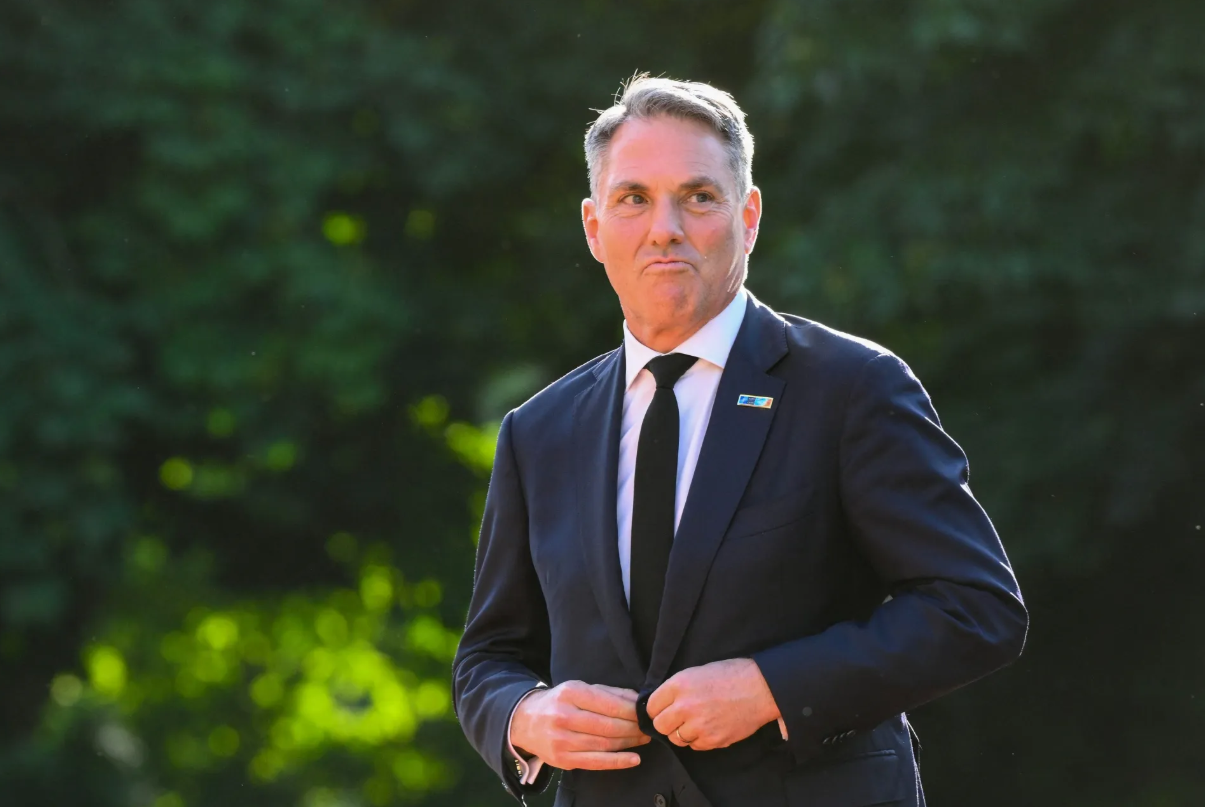
A Political Career Built Over Decades
Richard Marles occupies one of the most powerful positions in contemporary Australian politics. As Deputy Prime Minister and Minister for Defence, he sits at the centre of decisions involving national security, Australia’s military capabilities and the country’s strategic relationships with allies and regional partners. His political career, however, began long before he reached the senior leadership of the federal government.
Born in 1967 and raised in Geelong, Victoria, Marles developed a strong connection with the city that would later become central to his political identity. He studied at the University of Melbourne, completing degrees in law and science, a combination that provided a broad academic background before his eventual entry into federal politics.
Marles was elected to the House of Representatives as the member for Corio in 2007. He has subsequently been re-elected repeatedly, including at the 2025 federal election, making him one of the more experienced members of the current Labor government.
Early Government Responsibilities
Marles’ rise through federal politics was gradual. During previous Labor governments he held several parliamentary secretary and ministerial positions, gaining experience in areas including industry, Pacific affairs, foreign affairs and trade.
These responsibilities were important in developing the international focus that would later become particularly relevant to his role as Defence Minister. Australia’s geographic position means that foreign policy, Pacific relations and defence are closely connected. Political experience involving Australia’s neighbors therefore provided Marles with a useful foundation for later responsibilities.
He served briefly as Minister for Trade in 2013 and subsequently held a number of senior opposition portfolios during Labor’s years outside government.
Rather than disappearing from national politics during those opposition years, Marles became increasingly important inside the Labor Party and eventually served as Deputy Leader of the Opposition.
Deputy Prime Minister
Labor’s victory in the 2022 federal election transformed Marles’ political position. He became Deputy Prime Minister under Anthony Albanese and was appointed Minister for Defence, giving him responsibility for one of the government’s most strategically important portfolios. He remains Deputy Prime Minister and Defence Minister in 2026.
The deputy prime ministership is unusual because its importance can vary considerably depending on circumstances. The holder must support the prime minister, participate in major government decisions and be prepared to act as prime minister when required.
For Marles, the defence portfolio gives the position additional weight. Australia is navigating a period of significant strategic change in the Indo-Pacific, while simultaneously undertaking some of the most ambitious defence procurement projects in its history.
Defence and the Changing Indo-Pacific
Australia’s strategic environment has become increasingly central to national politics. Competition between major powers, tensions in the Indo-Pacific and questions about military preparedness have placed defence policy near the top of the government’s agenda.
As Defence Minister, Marles has been closely associated with Australia’s efforts to reshape the Australian Defence Force for this environment. That involves decisions about personnel, military infrastructure, naval capabilities, long-range weapons and cooperation with international partners.
AUKUS is perhaps the most internationally recognizable element of this strategy. The security partnership between Australia, the United Kingdom and the United States includes Australia’s plan to acquire conventionally armed, nuclear-powered submarines.
The project is extraordinarily complex. It involves not simply purchasing submarines but developing infrastructure, training personnel, building industrial capacity and maintaining political cooperation across multiple governments and decades. For Marles, this means that defence policy is as much about long-term planning and diplomacy as it is about immediate military decisions.
The United States and Australia’s Alliances
Australia’s alliance with the United States remains one of the foundations of its defence policy. Marles has repeatedly operated within this broader framework, participating in discussions with American officials and emphasizing interoperability between the Australian and US militaries.
At the same time, Australia’s strategic policy cannot focus exclusively on Washington. Relationships with Japan, India, Pacific Island countries and Southeast Asian nations also form part of the regional environment.
This creates a complicated balancing task. Australia wants strong alliances while also maintaining constructive relationships throughout a region containing countries with different strategic priorities.
Marles’ previous experience in Pacific and foreign affairs therefore remains relevant. Defence diplomacy increasingly involves building trust, coordinating training, developing infrastructure and demonstrating that Australia’s engagement with neighboring countries extends beyond military competition.
The Enormous Challenge of Defence Procurement
One of the least glamorous but most important parts of the Defence Minister’s job involves procurement. Military projects frequently cost billions of dollars and take many years to complete. Governments must therefore make decisions today about capabilities Australia may not receive until the following decade.
Submarines are only one example. Naval shipbuilding, aircraft, missile systems, cyber capabilities and military infrastructure all compete for funding.
In August 2026, Marles was again publicly discussing the Hunter-class frigate program as the government defended the project’s schedule and capabilities amid scrutiny over the ships’ increasing displacement and earlier decisions affecting their design.
Such debates demonstrate the political difficulty of defence procurement. A government must justify enormous expenditure while simultaneously acknowledging that many of the benefits will not become visible for years.
A Political Style Different from Populist Leadership
Marles generally projects a different political style from politicians who build their public identities around constant confrontation. His communication is frequently institutional and policy-focused, particularly when discussing defence and foreign affairs.
That does not remove him from political conflict. As one of the most senior members of the Labor government, he regularly faces opposition criticism and parliamentary scrutiny. Defence spending, military procurement and Australia’s relationship with major allies naturally produce intense debate.
His position also makes him an obvious target whenever the government experiences difficulties. The deputy prime minister cannot operate as a specialist minister alone; he is inevitably associated with the performance of the government as a whole.
Geelong and Personal Identity
Despite occupying a national role, Marles has maintained a strong public connection with Geelong. His electorate of Corio includes the region, and his identity as a Geelong representative has remained an important part of his political profile.
This local connection illustrates a fundamental feature of Australia’s parliamentary system. Even politicians who become national leaders continue to represent individual electorates and must maintain relationships with local communities.
Marles’ interests outside politics include Australian rules football, particularly the Geelong Cats, as well as golf, photography and local history. His official biography also notes that he lives in Geelong with his wife Rachel and has four children.
Richard Marles and Australia’s Strategic Future
The significance of Richard Marles’ career will ultimately be judged partly through decisions whose consequences may not become clear for many years. Defence policy operates on unusually long timelines, and major programs initiated today can shape Australia’s military capabilities for generations.
As Deputy Prime Minister, Marles is also positioned near the centre of the broader Labor government. His influence therefore extends beyond defence even though national security remains the portfolio most closely associated with his public profile.
From a Geelong electorate to the deputy leadership of the country, his career demonstrates the gradual nature of advancement within Australian parliamentary politics. More importantly, his current responsibilities place him at the centre of one of Australia’s most consequential debates: how the country should protect its interests and position itself in a rapidly changing Indo-Pacific region.